The Panchatantra Collection
20 pages · 15 min · ages 8+
Based on: Indian (3rd century BCE)
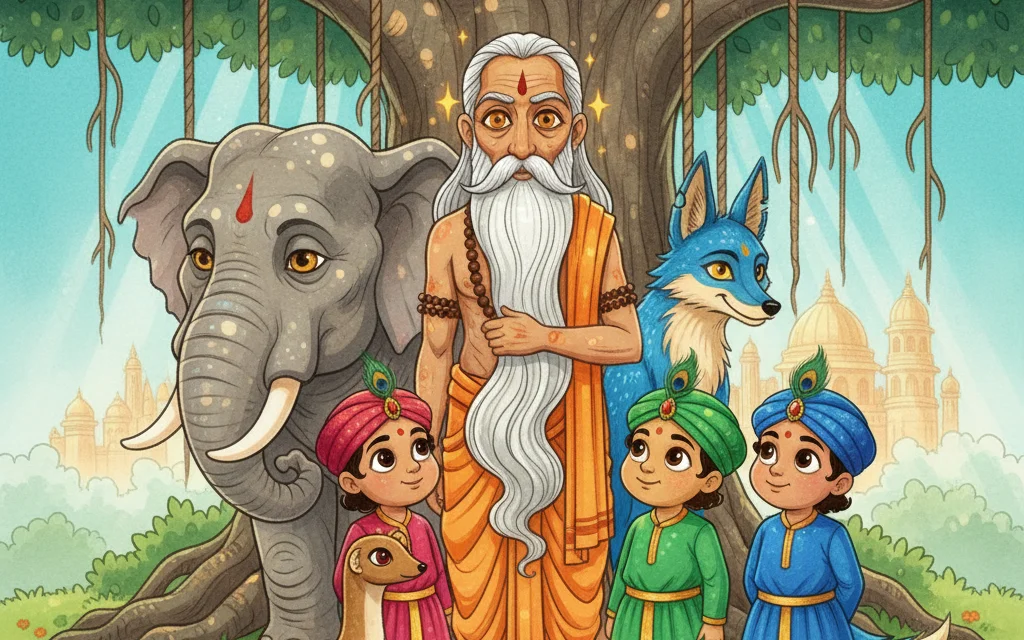
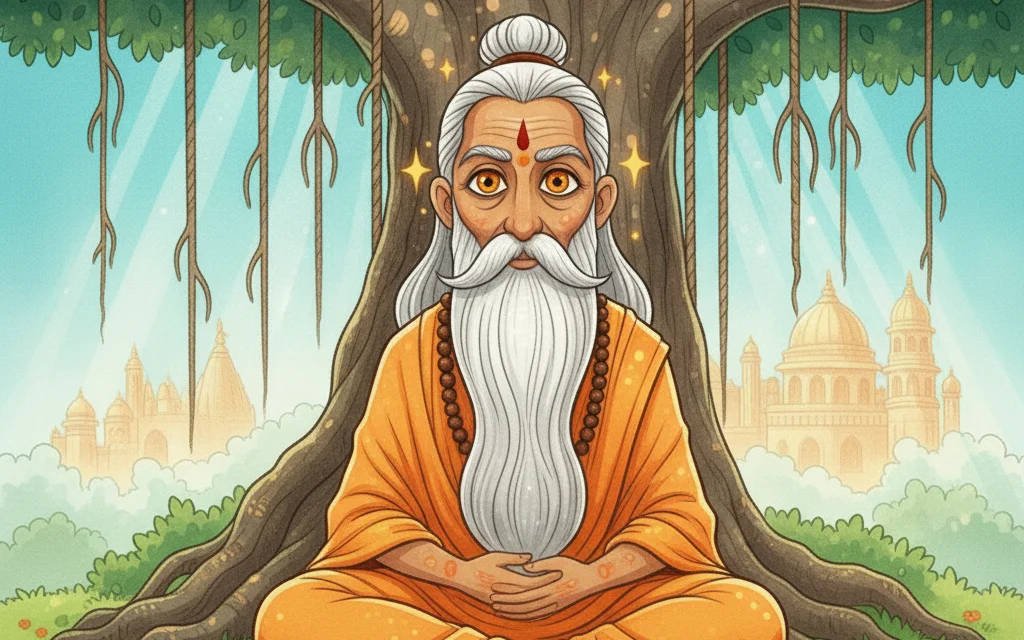
In the golden heart of ancient India, beneath the sprawling, emerald canopy of a majestic banyan tree, sat the venerable sage Vishnu Sharma. His silver beard flowed like a mountain stream, and his eyes shimmered with the light of a thousand sunsets as he greeted the three young princes who had come to seek his guidance. These boys were spirited but lacked the quiet wisdom required to lead a kingdom with grace and integrity. 'Wisdom,' Vishnu Sharma began, his voice a soothing melody, 'is not found in dusty scrolls alone, but in the rustle of leaves and the clever strategies of the forest dwellers.' The princes leaned forward, their youthful impatience replaced by a sudden, profound curiosity as the sage began his first tale.
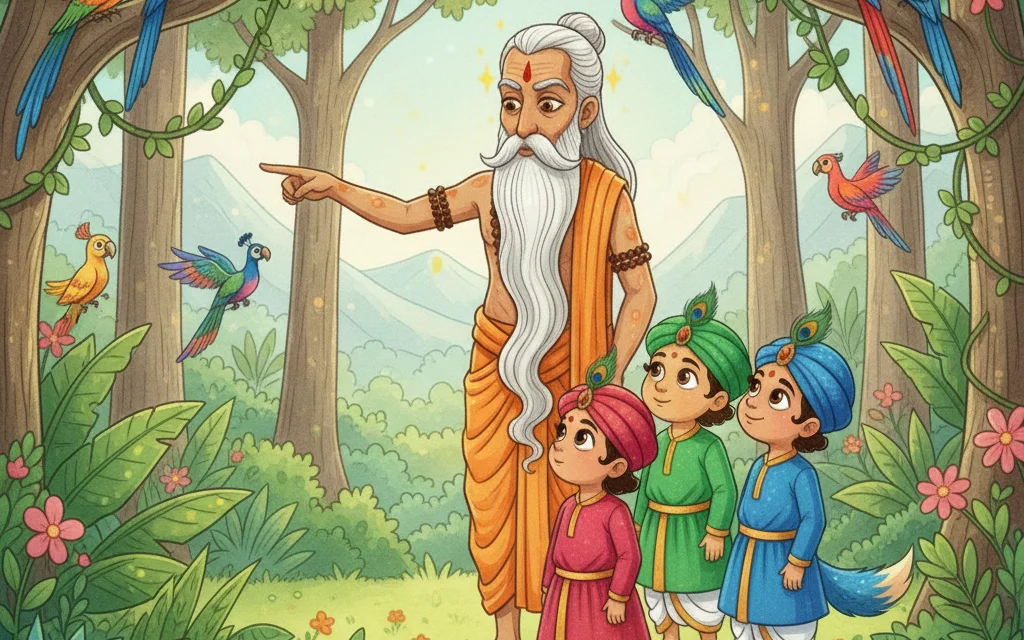
Vishnu Sharma gestured toward the lush jungle that bordered the palace gardens, where the air hummed with the vibrant songs of exotic birds. He explained that life is a complex tapestry woven from our choices, and understanding others is the first thread in that design. 'To govern others, you must first govern your own impulses and learn the value of a steady heart,' he whispered softly. The princes watched a colorful butterfly dance on a breeze, realizing that their lessons would be far more enchanting than they had ever imagined. With a mysterious smile, the sage introduced them to the concept of the Panchatantra—five frames of wisdom that would guide their moral compass forever.
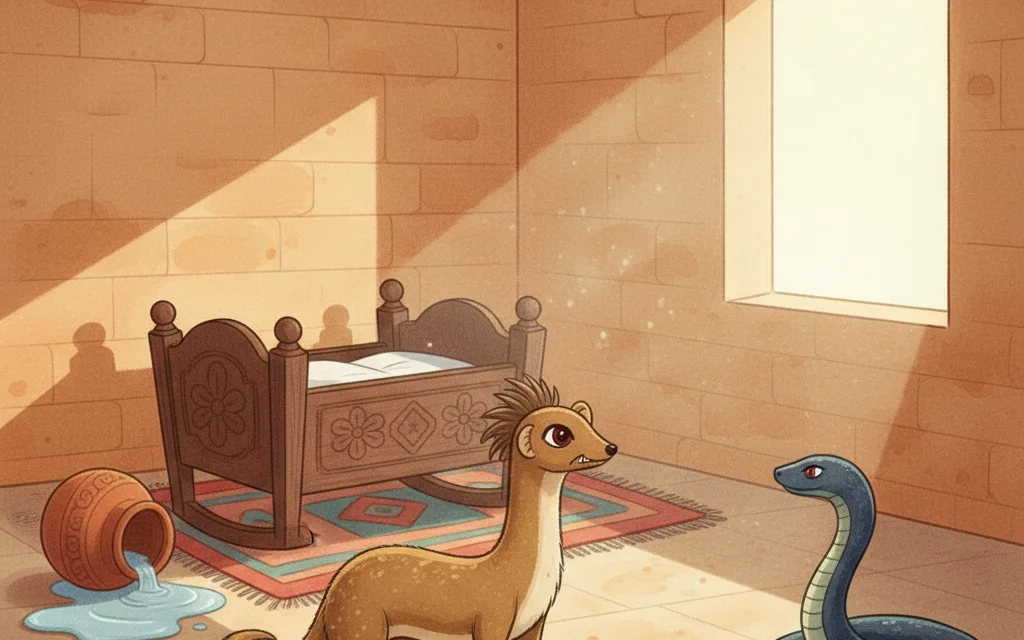
The first story concerned a humble mongoose who lived in the home of a kind farmer and his protective wife. This mongoose was not merely a pet but a loyal guardian who watched over the family’s tiny infant with unwavering devotion. One afternoon, while the mother was away gathering water, a dark and flickering shadow slithered across the threshold of the nursery. It was a large black cobra, its scales glistening like obsidian as it approached the sleeping child's cradle. The mongoose, sensing the imminent peril, did not hesitate for a single second to defend his tiny friend from the venomous intruder.
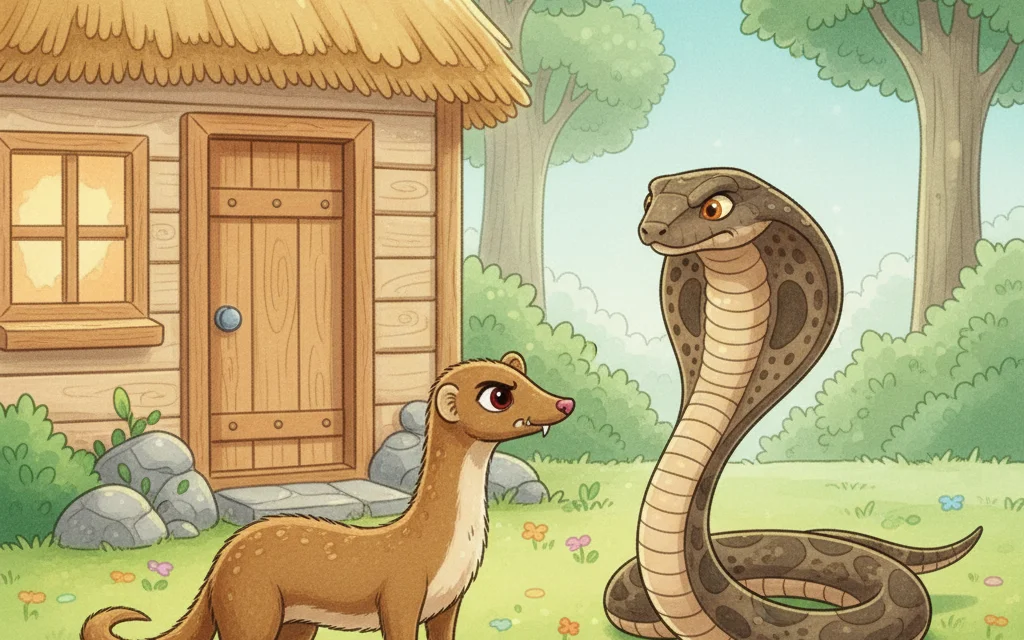
With a fierce display of courage, the mongoose lunged at the serpent, hissing and dancing with such agility that the cobra found itself completely outmatched. The mongoose did not wish to cause harm, but he stood his ground firmly until the frightened snake turned tail and vanished back into the shadows of the garden. Exhausted but victorious, the mongoose sat by the door, his fur slightly ruffled from the confrontation, waiting to be commended for his vigilance. He felt a sense of quiet pride, knowing the baby was safe and sound in its peaceful slumber. However, as the mother returned, she saw the mongoose’s excited state and jumped to a terrible, mistaken conclusion.

In her sudden panic, the mother dropped her heavy water pot, fearing the worst had happened to her precious child before she even looked inside. She scolded the poor mongoose harshly, her voice trembling with misplaced anger, until she rushed to the cradle and found her baby giggling at a sunbeam. Overcome with remorse, she realized that the mongoose had actually been a hero, and her impulsive judgment had almost cost her a loyal friend. Vishnu Sharma looked at the princes and said, 'Remember, children, one must always look closely and seek the truth before leaping to a conclusion. Haste is often the mother of regret, while patience is the father of understanding.'
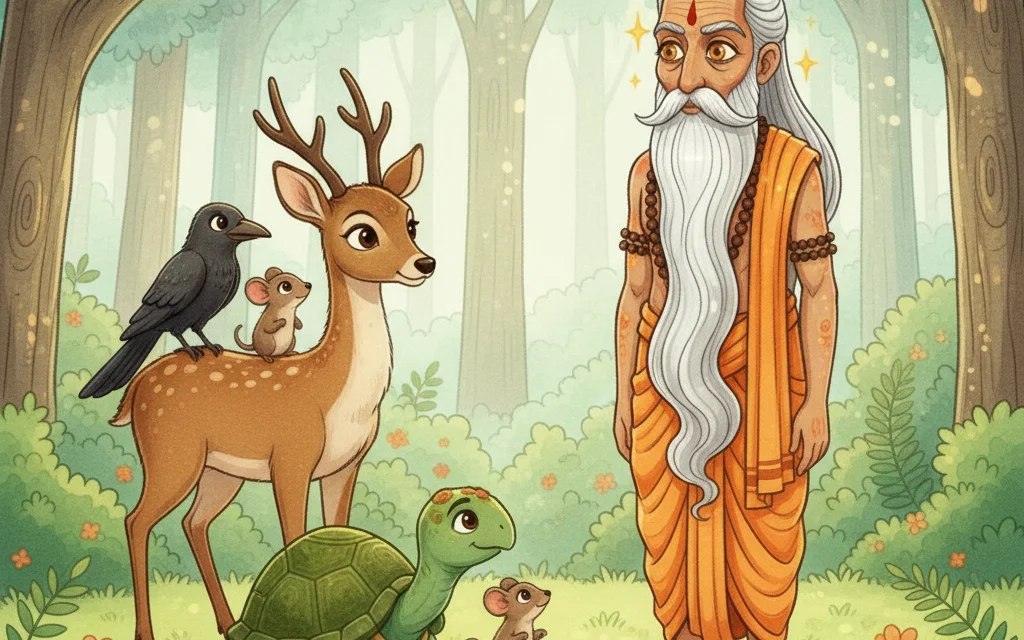
The princes nodded, their faces thoughtful, as the sage transitioned into his second tale about the extraordinary power of a united group. In a different part of the forest, there lived four unlikely companions: a graceful deer, a clever crow, a tiny mouse, and a slow but steady turtle. Despite their different sizes and species, they shared a bond that was stronger than the thickest vines in the jungle. They spent their afternoons sharing stories and warnings about the various dangers that lurked in the tall, golden grass. Their friendship was a testament to the idea that diversity is a strength, providing each of them with unique perspectives on survival.
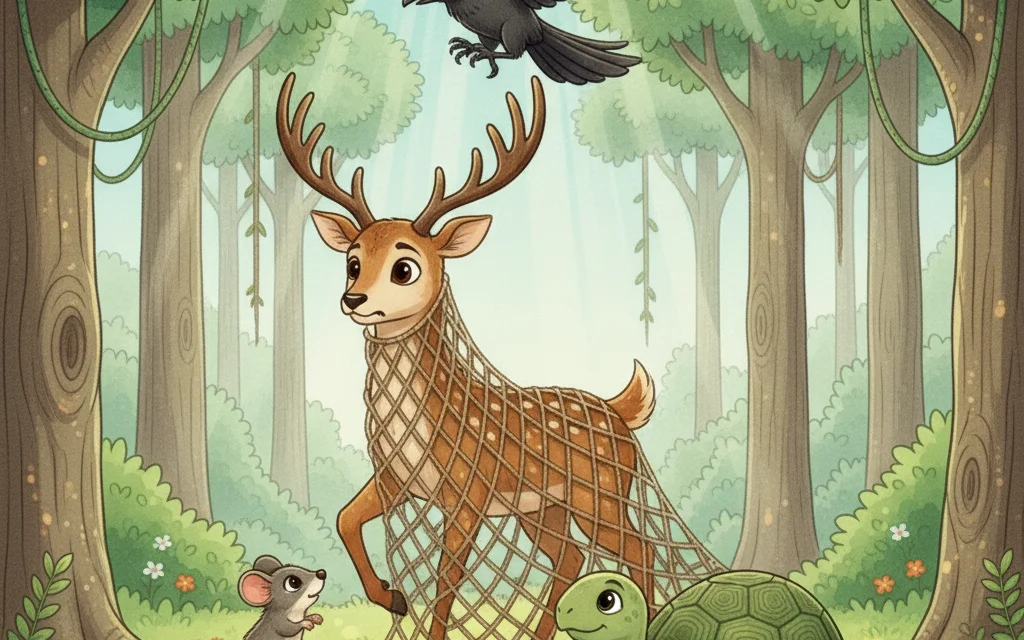
One day, the deer failed to return to their meeting spot near the shimmering lake, causing the other three friends to grow increasingly anxious. The crow took to the sky, his keen eyes scanning the landscape until he spotted the deer trapped in a hunter’s sturdy hemp net. He flew back with frantic caws to alert the mouse and the turtle, who immediately began to formulate a daring rescue plan. They knew that individually they were quite small or slow, but together they possessed the necessary tools to overcome this dire obstacle. The mouse realized that his sharp teeth were the perfect instrument for the task at hand.
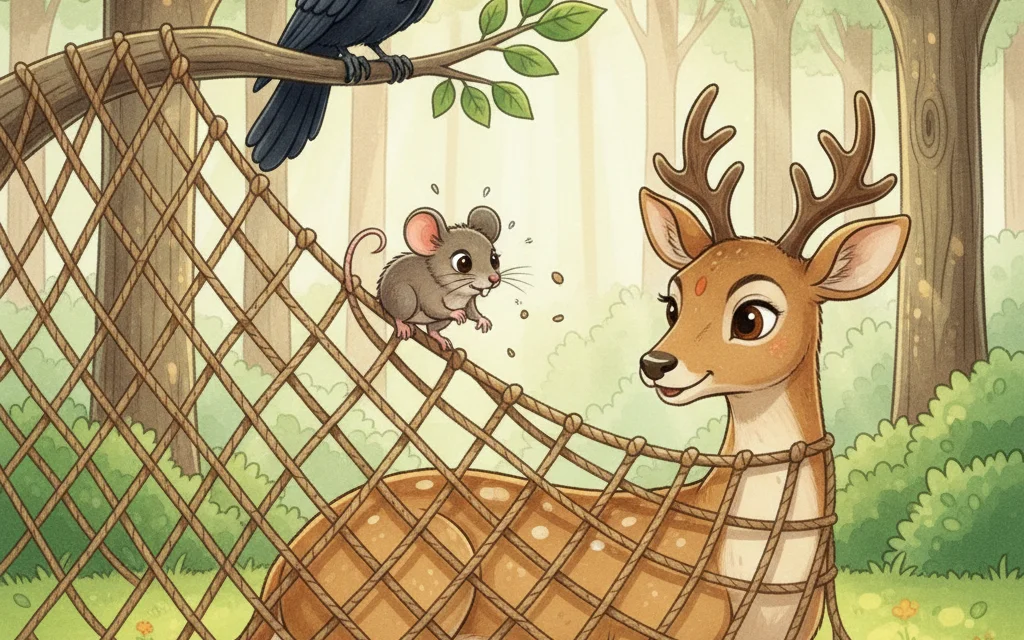
The crow guided the mouse to the trapped deer, while the turtle crawled as fast as his short legs would carry him to provide support on the ground. With industrious precision, the mouse began to nibble through the thick ropes of the net, his tiny heart racing with the urgency of the moment. As the final strand snapped, the deer leaped to freedom, but their celebration was cut short by the distant footsteps of the returning hunter. The friends realized that the turtle, being the slowest among them, was now in grave danger of being captured himself. It was time for another clever strategy to ensure that no member of their group was left behind.
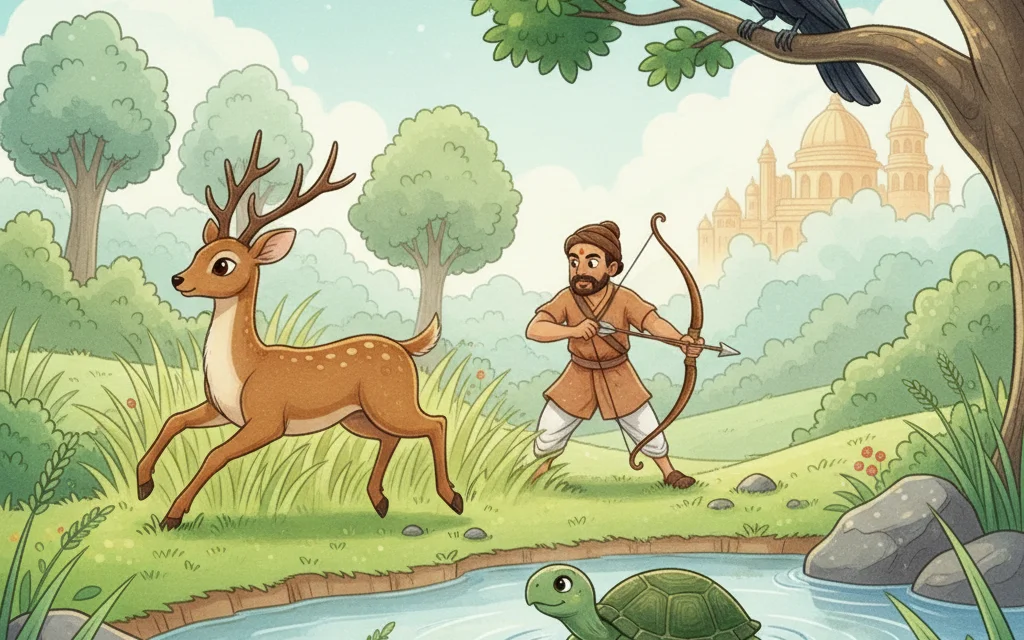
The deer pretended to be injured near the path, luring the hunter away from the area where the turtle was hiding in the tall grass. While the hunter chased the seemingly limping deer, the crow gave signals from above to ensure the deer stayed just out of reach but close enough to keep the hunter's attention. This clever distraction allowed the turtle to slip quietly into the safety of the deep, cool water of the nearby pond. Once everyone was safe, they reunited under the moonlight, laughing at how their coordinated efforts had completely outwitted the man. They had proven that a small mouse and a slow turtle could be just as heroic as a swift deer when they worked as one.
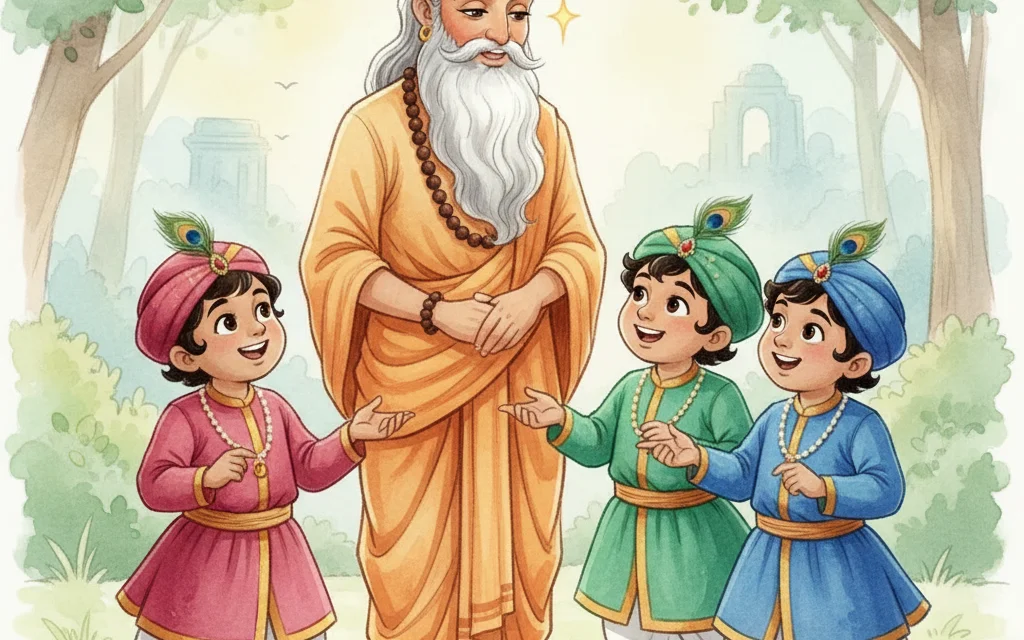
Vishnu Sharma smiled as he noticed the princes whispering among themselves about how they could help each other more often. 'A single straw is easily broken, but many straws woven together can tether an elephant,' the sage remarked with a twinkle in his eye. He explained that friendship is not just about having fun, but about being there when the shadows grow long and the path becomes uncertain. The princes began to realize that their royal status didn't mean they were superior, but rather that they had more people to protect and cherish. With the lesson of unity firmly planted, the sage prepared to tell a story about the dangers of pretense.
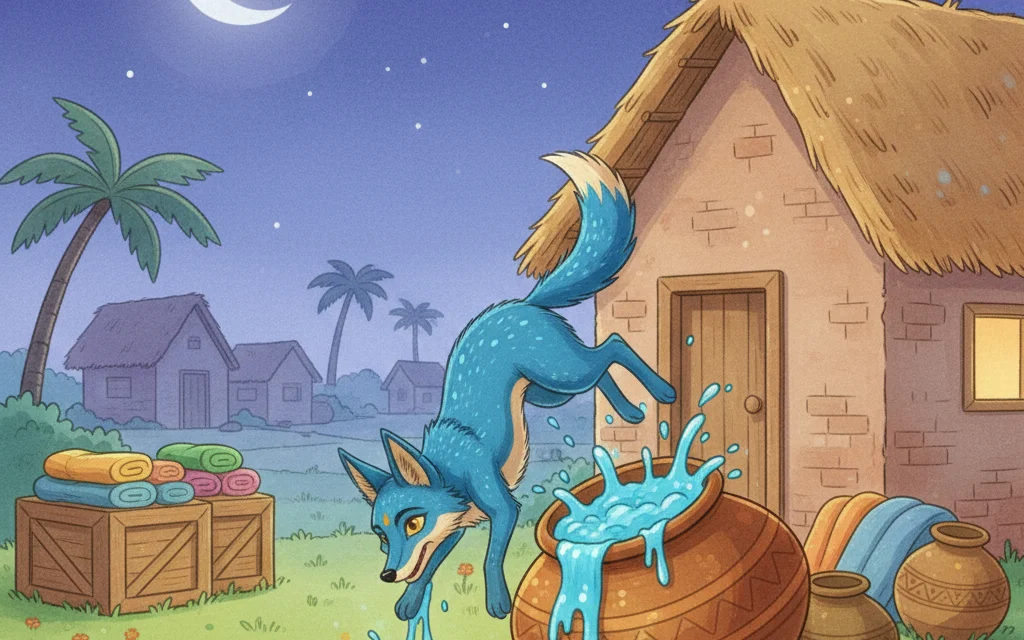
The third story featured a jackal named Chandarava, who was often dissatisfied with his humble life and sought a way to appear more important than he truly was. One evening, while scavenging near a dyer’s house in the village, he accidentally tumbled into a large vat of indigo dye. When he emerged, he was startled to find that his fur had turned a brilliant, shimmering shade of electric blue. He looked at his reflection in a puddle and realized that none of the forest animals would ever recognize him in this vibrant, regal hue. Seeing an opportunity for greatness, he decided to use this accidental transformation to trick the other creatures into serving him.
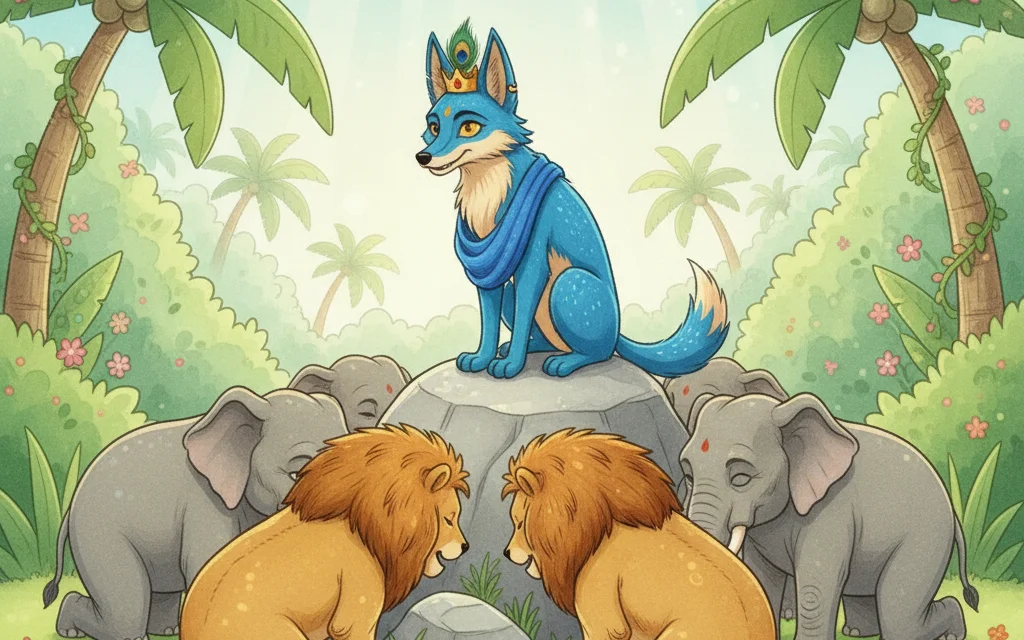
Chandarava returned to the forest and announced to the gathered animals that he had been sent by the heavens to be their supreme king. The lions, tigers, and elephants were so dazzled by his unique blue coat that they bowed down, believing his dishonest claims without question. For many weeks, the jackal lived in luxury, enjoying the finest fruits and the most comfortable resting spots while the other animals did his bidding. He felt quite smug in his deception, convinced that his outward appearance was enough to sustain his new, exalted lifestyle indefinitely. However, a lie is like a heavy coat in summer; it becomes increasingly difficult to carry as time goes on.
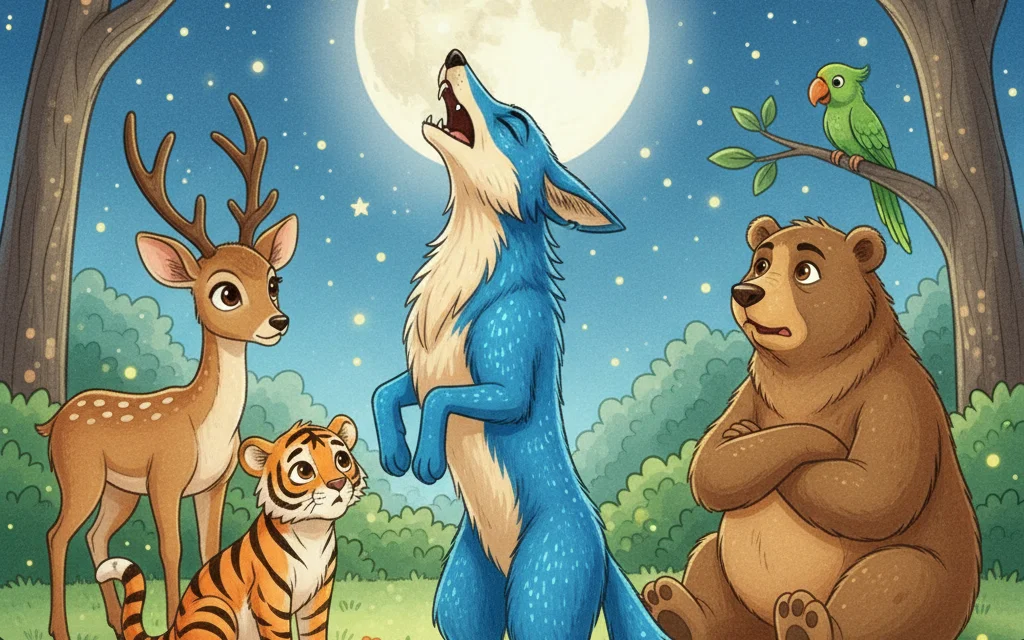
One fateful evening, a pack of ordinary jackals began to howl at the full moon, their haunting melody echoing through the ancient trees. Chandarava, forgetting his royal charade, felt an uncontrollable urge to join in the song of his own kind, for his heart was still that of a jackal. He lifted his blue snout to the sky and let out a long, piercing howl that instantly revealed his true identity to the listening court. The other animals stopped in their tracks, realizing that their 'heavenly king' was nothing more than a common jackal in a blue disguise. They weren't angry so much as they were deeply disappointed by his lack of honesty and self-respect.
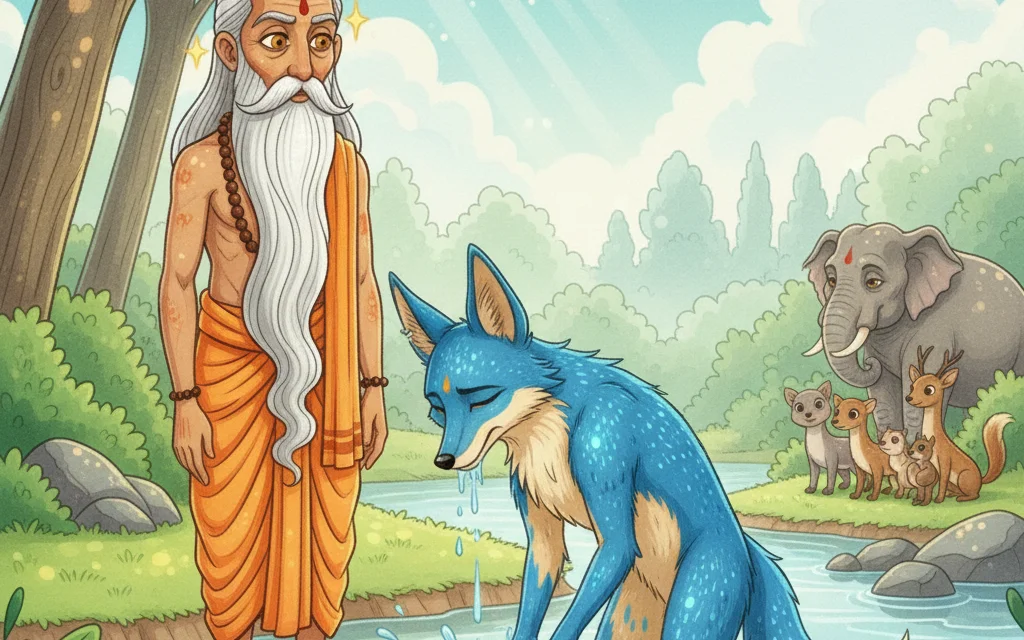
Embarrassed and stripped of his false titles, the blue jackal had to explain that he only wanted to feel special, but he learned that true respect cannot be stolen. The animals told him that they would have liked him just as much as a regular jackal if he had only been truthful from the start. Chandarava spent a long time washing the blue dye from his fur, realizing that his natural coat was far more comfortable than a lie. Vishnu Sharma turned to the princes and noted, 'Authenticity is a crown that never tarnishes, whereas deceit is a mask that eventually slips.' The princes felt a pang of understanding, recognizing how much easier it is to simply be oneself.
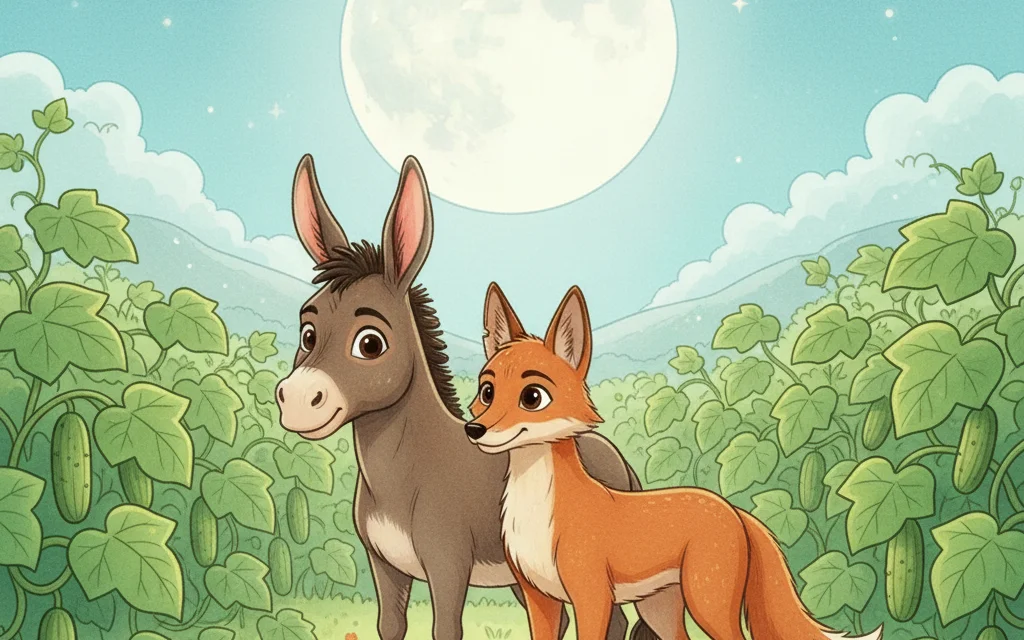
The fourth story was about a donkey who possessed a great love for music but lacked the wisdom to know when his singing was appropriate. He would often wander through the fields at night with his friend, a wise jackal, searching for delicious cucumbers to munch on under the stars. One particularly beautiful night, the donkey felt a surge of artistic inspiration and decided that he simply must sing a song to celebrate the moonlight. The jackal, sensing danger, warned his friend that his voice was more of a loud bray than a sweet melody, especially in the quiet of the night. 'Patience and timing are the soul of music,' the jackal whispered, trying to prevent a catastrophe.
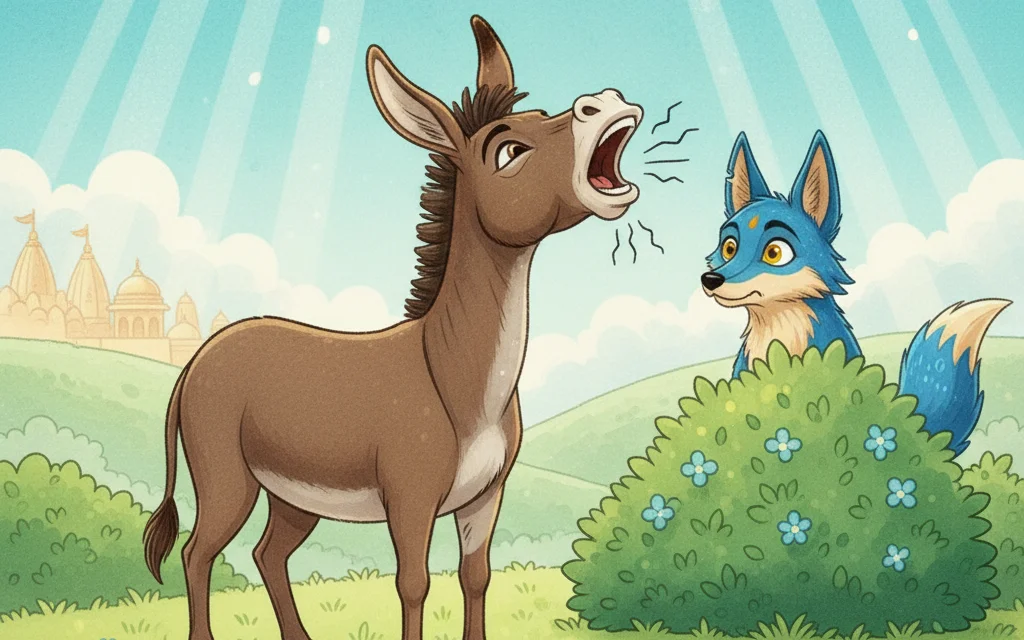
Ignoring his friend’s sage advice, the donkey insisted that his voice was a gift that the world deserved to hear right that very instant. He believed that his passion was more important than the practical reality of their situation, illustrating a common folly of the young and headstrong. The jackal sighed and stepped back into the shadows, knowing that some lessons can only be learned through the consequences of one's own actions. The donkey cleared his throat, puffed out his chest, and let out a series of thunderous, echoing brays that shattered the silence of the countryside. He felt very proud of his performance, unaware that he was ringing an alarm for the entire village.
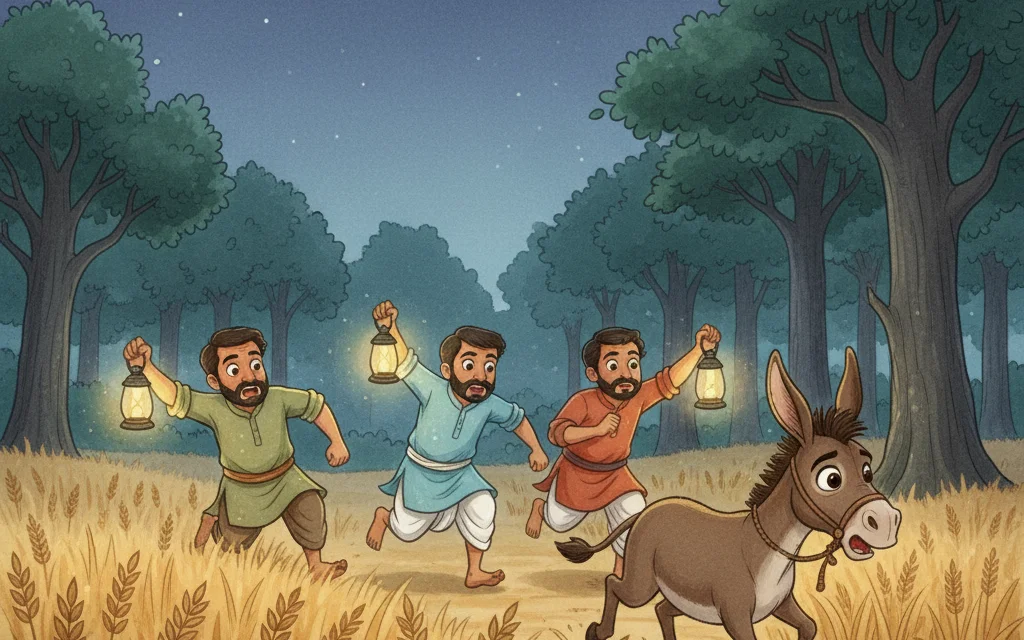
The farmers, startled from their sleep by the cacophony, rushed into the fields thinking a thief or a wild beast was among their crops. The donkey, realizing his mistake too late, had to scramble away into the forest to avoid being scolded for waking everyone up. He returned to the jackal, feeling rather silly and admitted that perhaps his timing had been a bit poorly chosen. The jackal kindly explained that even the most beautiful song can become a nuisance if it is performed at the wrong moment. From that day on, the donkey practiced his music during the day and learned the value of listening before he spoke—or sang.
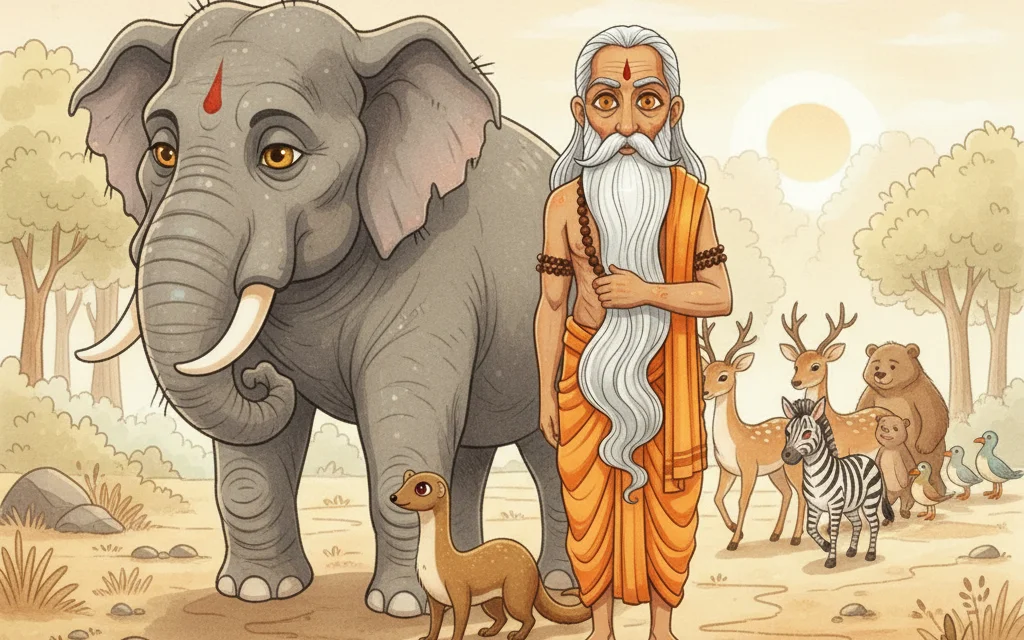
To conclude his lessons, Vishnu Sharma told the final story of a great, kind elephant named Gaja who was the protector of the entire forest. Gaja was wise and patient, using his immense strength not to dominate others, but to clear paths for the small and provide shade for the weary. He had seen the mongoose's bravery, the friends' loyalty, the jackal's mistakes, and the donkey's growth over many seasons. One year, a great drought hit the land, and the forest creatures were worried about where they would find enough water to survive the heat. Gaja remembered a hidden spring deep within the mountains and decided to lead all the animals on a journey to find it.
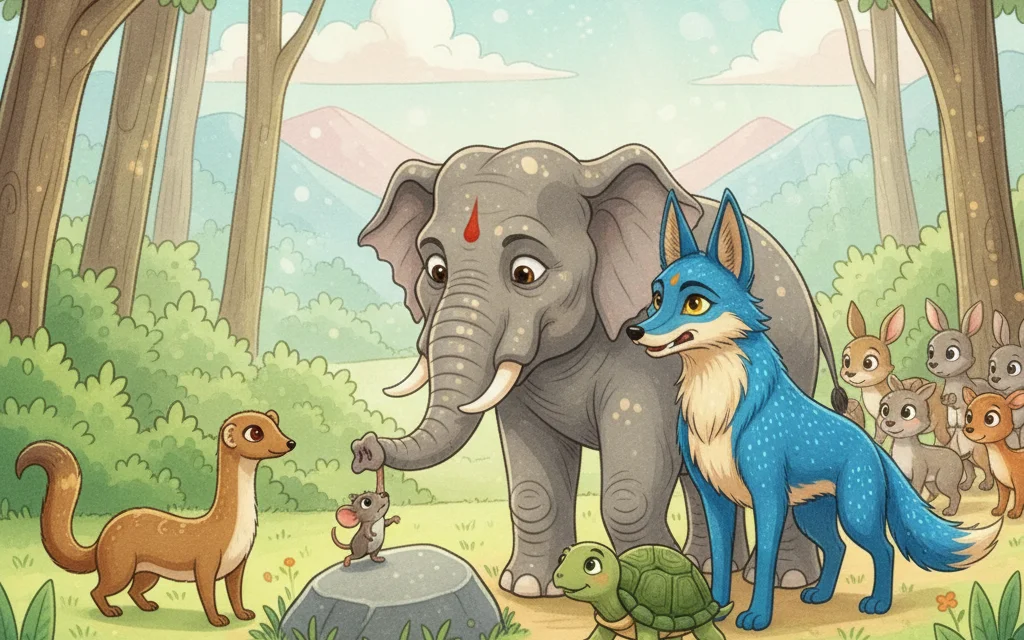
The elephant moved slowly to ensure the turtle could keep up, and he used his trunk to lift the mouse over difficult rocks that blocked the way. He encouraged the blue jackal to be honest about his fears and praised the mongoose for keeping a watchful eye on the younger animals during the trek. The donkey even provided a bit of rhythmic tapping with his hooves to keep everyone's spirits high as they marched through the dust. Gaja showed them that a true leader is someone who serves the needs of the group and ensures that every member, no matter how small, is valued. His kindness was the glue that held the diverse group together during their most challenging time.
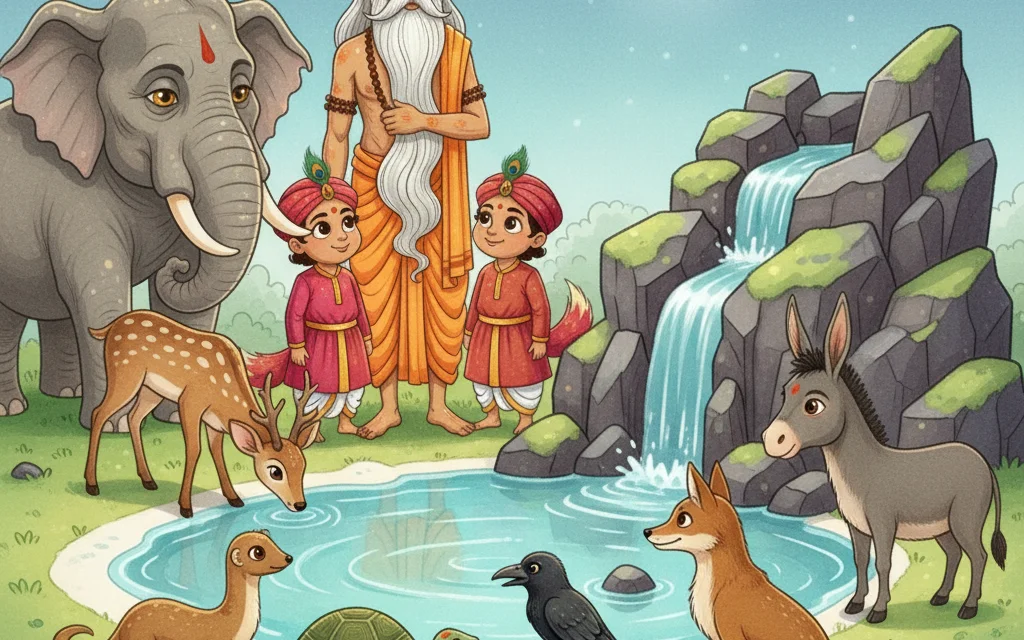
When they finally reached the shimmering mountain spring, the animals celebrated their survival and the wisdom they had gained from each other’s stories. Vishnu Sharma looked at the three princes, who were now sitting quietly with expressions of deep understanding and newfound maturity. They realized that honesty, friendship, patience, and kindness were the true jewels of any kingdom, more precious than gold or silk. The sage smiled, knowing that these boys would grow up to be kings who ruled with their hearts as well as their minds. In the forest nearby, the animals gathered in a peaceful circle, their voices joining in a harmonious chorus that echoed the eternal wisdom of the Panchatantra.